


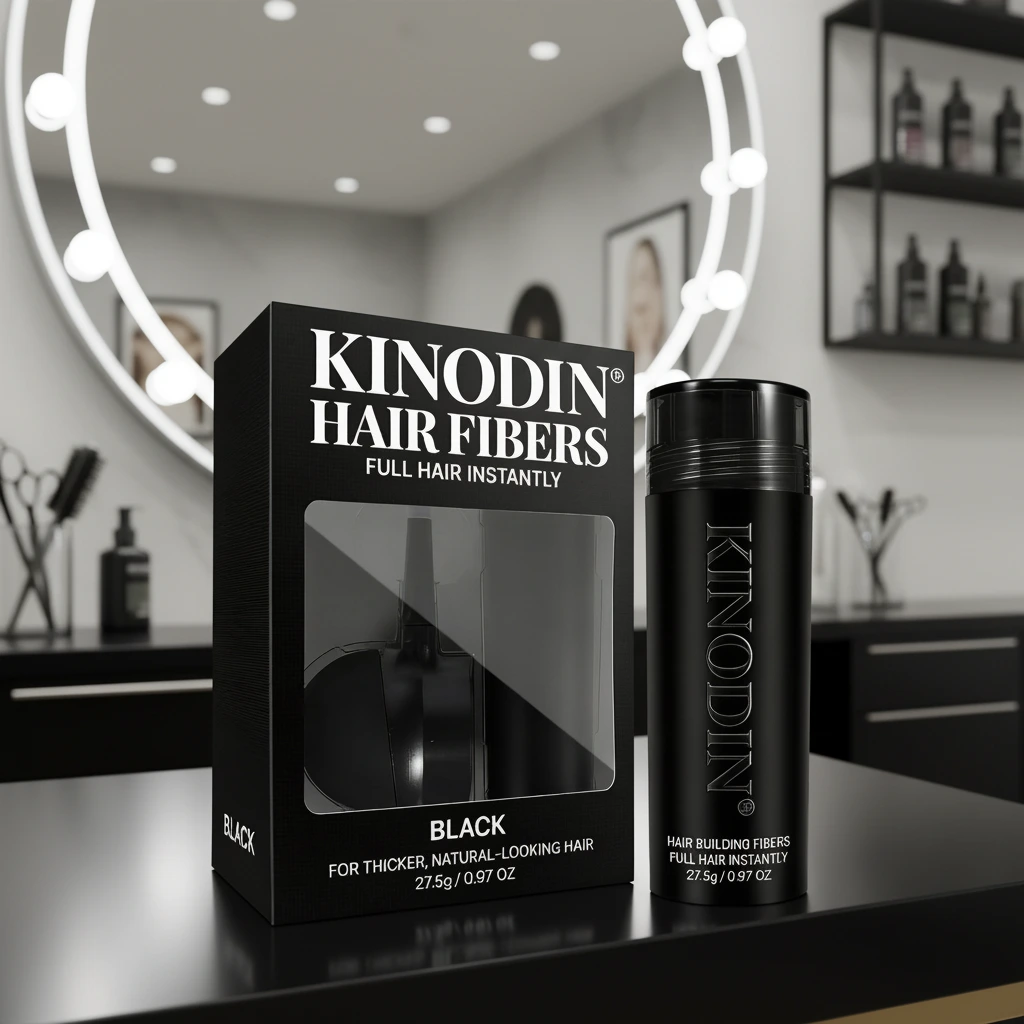
Private Label Keratin Hair Fiber Spray Applicator Kit
Private Label Keratin Hair Fiber Spray Applicator Kit
KINODIN develops private label keratin hair fiber kits that combine a dry fiber bottle with a compatible manual spray applicator for more directed placement. This 2-in-1 format is designed for hair-concealer brands, distributors, salons and e-commerce retailers that want a coordinated coverage system rather than a bottle alone. Projects may include keratin material verification, fiber specification, nine standard shade directions, bottle-to-applicator compatibility, custom labels, retail cartons and finished-kit quality checks. The fibers provide temporary cosmetic coverage and a fuller-looking appearance; they do not prevent hair loss or stimulate growth. Final contents, claims, packaging and documents are confirmed for each project.
What Does “2-in-1” Mean on This Product?
The 2-in-1 description refers to two physical components: a bottle of dry keratin-based hair building fibers and a reusable manual spray applicator. The applicator connects to the compatible bottle through an adapter and uses hand pressure to direct the dry fibers. It is not a spray formula, liquid treatment, dual-active powder or hair-growth system.
This definition should be shown clearly in the title, product attributes, images and FAQ. Ambiguous wording such as “2-in-1 formula” can mislead buyers into expecting two ingredients or two treatment functions. A clear kit structure also gives this page a distinct purchasing intent within KINODIN's private label hair building fibers range.
How This Kit Differs from Other Hair Fiber Pages
| Product page | Main material or format | Core difference | Buyer intent |
|---|---|---|---|
| This kit | Keratin fibers + manual applicator | Directed application system | Complete two-component retail kit |
| Standard keratin bottle | Keratin fibers | Simple sifter or shaker format | Core single-SKU product |
| Plant-based applicator kit | Confirmed cotton or plant-derived fibers | Plant-based material positioning | Alternative-material product line |
| 12g / 15g / 27.5g bottles | Size-specific formats | Compact, standard or professional capacity | Net-content and channel selection |
The same page should not alternate between keratin and cotton, or between a bottle and an applicator kit. Confirmed material and kit contents determine the correct category, artwork and internal links.
Keratin Fiber Specification
The proposed kit uses keratin-based dry fibers. Material identity, supplier, composition, colorants and batch traceability should be confirmed before the page or label calls the product keratin. A typical keratin-fiber project may evaluate dimensions around 0.4–0.6 mm where appropriate, but the final length distribution, texture and bulk density must follow the approved product specification.
Keratin does not automatically establish pure, natural, organic, herbal, vegan, hypoallergenic or irritation-free status. If the actual approved material is cotton or another plant-derived fiber, move it to KINODIN's cotton hair building fibers range instead of keeping contradictory keratin wording.
Manual Spray Applicator Compatibility
The applicator is a dispensing accessory for dry fibers. Its performance depends on the complete system: bottle neck, adapter, gasket, tube or internal pathway, pump bulb, nozzle geometry, fiber dimensions, bulk density, static behavior and filling level. An applicator that fits one bottle visually may still leak, clog or release an inconsistent amount with a different fiber.
Compatibility review should use the actual production-intent bottle and finished fibers. Testing can cover connection security, seal, repeated pumping, output direction, spray spread, blockage, fiber residue and continued function as the fill level changes. The kit should be approved as a system rather than as two unrelated components.
Directed Application and Hairline Control
A manual applicator can help direct fibers toward a smaller area compared with shaking from an open sifter. This may support crown, part-line or hairline-focused product concepts when used with appropriate instructions and existing hair. The finished output depends on the nozzle, distance, pump force, fiber specification and application technique.
The applicator does not guarantee perfect precision, zero mess or complete concealment. Brands may add a compatible hairline optimizer or comb as a separate accessory if the retail system requires more defined edges. Each added component should have its own fit, material, cleaning and packaging review.
Nine Standard Shade Directions
KINODIN's confirmed standard system includes Black, Dark Brown, Medium Brown, Light Brown, Dark Blonde, Medium Blonde, Light Blonde, Gray and White. A kit line may start with fewer shades according to the target customer and sales channel, while custom color development can be evaluated using a physical reference.
Color names alone do not define undertone, depth or manufacturing tolerance. The buyer should approve physical samples under relevant lighting and with the intended application method. The applicator can alter visual distribution, so evaluation should use both sifter and pump application when both methods will be shown. Review KINODIN's hair concealer color matching process.
Bottle, Adapter and Retail Box Development
The fiber bottle must provide the correct net-content capacity, functional headspace and a neck that works with the selected adapter. Packaging development may cover bottle size and color, sifter or inner closure, cap, applicator finish, gasket, label, direct printing, individual carton, insert, shade identification and batch coding.
A retail box should keep the bottle and applicator secure during distribution without pressing or deforming the bulb and nozzle. If the applicator is packed separately, the insert and instructions should show how to connect it without spilling product. KINODIN can review the complete system through its packaging development service.
Optional Hold Spray and Expanded Kits
The confirmed 2-in-1 product contains fibers and an applicator. A separate fiber hold spray may be added only when the buyer intentionally develops a three-component kit. It should not be implied by the phrase 2-in-1 or confused with the dry-fiber applicator.
When a hair fiber hold spray is included, its formula, bottle, pump, labeling, transport and compatibility require separate approval. Durability, humidity, moisture or transfer wording must be based on defined testing of the actual fibers, application method and hold-spray system.
Application Directions and Product Boundaries
Directions may instruct the user to apply the fibers to clean, dry and styled hair, connect the approved applicator correctly, direct small amounts toward the target area, build coverage gradually and avoid inhalation or contact with eyes. The exact wording, distance, number of pumps, warnings and cleaning steps should follow testing and destination-market review.
“For dry hair” describes an application condition, not a treatment for dry or damaged hair. The fibers temporarily reduce visible contrast between existing hair and scalp; they do not prevent hair loss, treat alopecia, restore follicles or create new hair. Claims such as suitable for all ages, safe for every scalp and completely undetectable should also be removed.
Finished-Kit Quality Control
Quality review should cover the keratin fibers, selected shades, filling, bottle, adapter, applicator, artwork and assembled retail kit. The approved fiber sample, shade reference, component drawings and packaging standard establish the release criteria.
| Control area | Example checks | Purpose |
|---|---|---|
| Fiber material | Identity, supplier records, dimensions, appearance, moisture and traceability | Confirm the approved keratin-based input |
| Shade and flow | Color reference, bulk density, static behavior and visual distribution | Control appearance and output consistency |
| Filling and bottle | Net content, fill level, headspace, neck, closure and cleanliness | Support capacity and reliable assembly |
| Applicator system | Fit, seal, pumping, spray pattern, blockage, residue and repeated use | Verify functional compatibility |
| Assembled kit | Component count, shade ID, coding, artwork, insert and transport protection | Release the correct two-component SKU |
See KINODIN's quality control page for the broader project process.
Documentation Support
Available documents may include raw-material specifications, supplier certificates, colorant information, batch traceability records, a finished-product specification, certificate of analysis, safety data information where applicable, bottle and applicator specifications, artwork records and selected quality documents. Availability depends on the confirmed fiber, shades, packaging and destination market.
General manufacturing certificates do not prove that the product is organic, vegan, hypoallergenic, waterproof, scalp-safe or clinically effective. The buyer remains responsible for final label review, local notification or registration and advertising requirements. Agree the required document list before artwork and order approval.
Samples, MOQ and Lead Time
Sampling can evaluate keratin material, shade, fiber dimensions, bottle capacity, applicator fit, output pattern, blockage, repeated use and retail-pack presentation. A pre-production kit should use the selected production-intent fiber, bottle, adapter, applicator, label and box whenever available.
MOQ depends on quantity per shade, fiber preparation, bottle, net content, applicator, adapter, decoration, carton, insert, testing and documents. Lead time is confirmed after all components, artwork and release requirements are approved. Samples are not automatically free. Review KINODIN's MOQ and sampling guidance.
Private Label Development Process
Define the kit
Confirm market, keratin material, net content, shades, channel and two-component pack.
Match the dispensing system
Select the bottle, adapter, gasket and manual applicator for the approved fibers.
Approve shades and samples
Evaluate visual blend, flow, spray direction, residue and repeated-use function.
Finalize packaging and claims
Approve the label, box, insert, directions, warnings, shade identification and coding.
Produce and assemble
Prepare approved shades, fill bottles and assemble each verified kit component.
Inspect and release
Check the finished fibers, applicator function, component count and retail package.
Frequently Asked Questions
What is included in the 2-in-1 kit?
The confirmed concept contains one bottle of dry keratin hair building fibers and one compatible manual spray applicator. Final component count and net content must be shown in the approved specification.
Is the applicator a liquid spray?
No. It is a manual dispensing accessory that directs dry fibers from the connected bottle. It does not contain liquid or use aerosol propellant.
Can every fiber bottle use this applicator?
No. The bottle neck, adapter, seal, pathway and nozzle must be compatible with the approved fiber and filling specification.
Are the fibers natural and organic?
Not automatically. The project is positioned as keratin-based hair building fibers. Natural or organic claims require separate material and finished-product evidence.
How many standard shades are available?
KINODIN's confirmed system contains nine shade directions. Final shades and custom matches should be approved using physical samples.
Can a hairline tool or hold spray be added?
Yes. Either can be evaluated as an additional component, but the product then becomes an expanded kit and requires separate compatibility, packaging and labeling review.
Does this kit prevent hair loss?
No. It is a temporary cosmetic hair-concealer system. It changes the visible appearance of areas with existing hair but does not affect hair growth or shedding.
What is the MOQ?
MOQ depends on shades, fiber preparation, bottle, applicator, adapter, decoration, boxes, inserts, testing and document requirements.
Can we approve a complete kit sample?
Yes. Sampling can cover the selected fiber, shade, bottle, adapter, applicator function and retail presentation before mass production.
Develop a Private Label Keratin Fiber Applicator Kit
Send KINODIN your destination market, keratin-fiber specification, target net content, shade mix, bottle and applicator references, retail channel, order quantity, artwork concept and document checklist. The team will review material, dispensing compatibility, sampling, packaging and finished-kit quality requirements before confirming a proposal.
Email: sales@kinodin.com Contact KINODINProduct notice: Hair building fibers are temporary cosmetic concealers. Material identity, fiber specification, shades, net content, bottle, applicator, directions, warnings, claims, testing and documents must be confirmed for the finished kit and destination market. This page is for B2B project discussion and does not represent the kit as a treatment or preventive product for hair loss.
contact us
contact us for free sample !
Copyright © 2026 Foshan Younik Cosmetics Co., Limited. All Rights Reserved.