


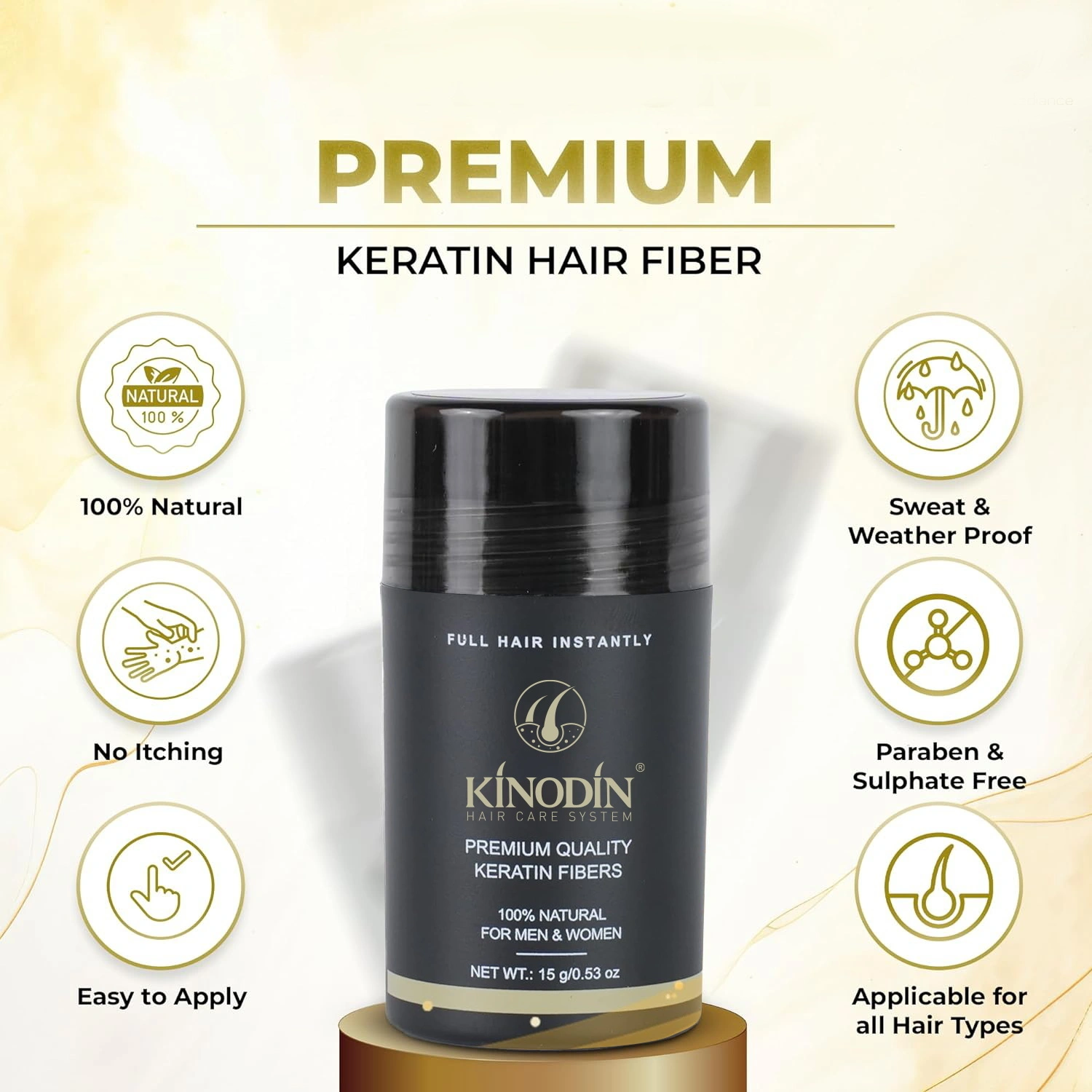
Private Label 15gram Keratin Hair Building Fibers
Private Label 15gram Keratin Hair Building Fibers
KINODIN manufactures private label 15gram keratin hair building fibers for hair-concealer brands, distributors, salons and e-commerce retailers. This compact retail format combines protein-based dry fibers with a compatible sifter bottle for controlled application to areas where existing hair is present. Projects may include nine standard shade directions, custom color matching, bottle and label selection, retail cartons, samples, applicators, hold spray and finished-product quality checks. The fibers provide temporary cosmetic coverage and help create a fuller-looking appearance; they are not a hair-growth treatment. Final material, claims, shades, packaging and documents are confirmed for each project.
What Is a 15gram Keratin Hair Building Fiber Product?
This is a dry, loose-fiber cosmetic product packed at a verified net content of 15 grams. It is designed for controlled application to areas where visible scalp contrasts with existing hair. The fibers distribute among the hair and temporarily reduce that visual contrast, helping the area appear fuller.
The 15g format gives this page a clear commercial role within KINODIN's broader private label hair building fibers range. It can serve as a compact standalone SKU, an introductory retail size or the fiber component in a coordinated concealer kit. It should not be presented as a treatment for thinning hair, baldness or hair loss.
Keratin Material and Source Verification
The product direction uses protein-based keratin fibers, commonly produced from a documented wool-derived source. The finished label should use the material name supported by the supplier specification, processing records and approved formula. “Keratin” describes a material category; it does not by itself prove that a product is superior, more natural-looking or more compatible with every user.
The page should not call the fibers “pure organic keratin,” “bio-identical to human hair” or “the same as real hair” without evidence supporting those exact statements. Incoming material review can cover source, composition, colorant information, specification, batch identification and available supplier documents. Buyers comparing material directions can review KINODIN's separate cotton hair building fibers collection without treating one category as universally better than the other.
Fiber Dimensions, Texture and Flow
A keratin fiber direction of approximately 0.4–0.6 mm may be evaluated for this product, but the final length distribution must come from the approved production specification. Fiber length, diameter, texture, bulk density, moisture and static behavior affect the way the product moves through the bottle and visually integrates with hair.
Fine fibers are not automatically “clump-free” or “completely undetectable.” Dispensing behavior also depends on the sifter geometry, fill level, shade formulation, environmental conditions and application amount. Samples should therefore be reviewed as a complete fiber-and-package system rather than judging the loose material alone.
Nine Standard Shade Directions
KINODIN's confirmed standard system contains nine shade directions. These commercial names support initial range planning, while the final color and approved tolerance should be established with physical samples.
| Shade family | Standard shades | Development focus |
|---|---|---|
| Dark | Black, Dark Brown | Depth, warmth and visible contrast |
| Brown | Medium Brown, Light Brown | Warm or cool undertone direction |
| Blonde | Dark Blonde, Medium Blonde, Light Blonde | Depth and appearance under different lighting |
| Silver | Gray, White | Blend with natural gray and white hair |
Additional commercial colors or controlled blended tones can be evaluated when volume and material preparation allow. Shade names alone are not sufficient approval references. Learn more about physical references, undertones and production standards on KINODIN's hair concealer color matching page.
15g Bottle and Sifter Development
The bottle, sifter and cap should be selected together with the approved fiber. A 15g fill requires sufficient internal capacity and headspace for the selected bulk density. Two fibers with the same net weight may occupy different volumes, so an attractive sample bottle cannot be approved solely from its nominal capacity.
Key packaging checks may include neck dimensions, sifter-hole pattern, closure fit, cap retention, dispensing rate, residual fibers around the opening, label area, batch coding and transport integrity. KINODIN can support stock bottle selection, custom colors, labels, direct printing, individual cartons and coordinated retail packaging. See the packaging development page for the wider B2B process.
Optional Precision Applicator
A compatible manual spray applicator can replace or connect to the standard sifter system when the brand wants more targeted placement near a hairline, part or temple. It mechanically disperses dry fibers and is not an aerosol or liquid spray. The accessory must be tested with the final bottle and fiber because nozzle pattern, blockage, pump recovery and output can change with fiber dimensions and fill level.
The applicator improves control of placement; it should not be described as improving adhesion, activating ingredients or increasing a treatment effect. Brands can compare accessory formats on the dedicated hair fiber applicator page.
Hold Spray Is a Separate Product
Loose fibers and hold spray perform different roles. The fibers provide temporary color and density contrast, while an optional setting spray may support the styling routine. A spray cannot justify unconditional claims that the fiber is waterproof, sweatproof, windproof or guaranteed to last all day.
When a complete kit is requested, the fiber and spray should each have their own formula, ingredient information, packaging, label, quality specification and market review. Visit KINODIN's private label hair fiber hold spray page for separate development options.
Private Label Packaging and Kit Options
Fiber bottle with sifter, cap, label or direct printing and individual carton.
15g fibers combined with a compatible manual applicator and optional hairline tool.
Fibers, applicator and separately formulated hold spray in coordinated retail packaging.
Retail bottle supported by a compatible refill format for repeat-order programs.
Refill packaging should be tested for transfer, closure integrity and correct shade identification. Related options are shown on the hair fiber refill packs page.
Finished-Product Quality Control
Quality review should cover the approved keratin fiber, shade, filled bottle and any included accessory. The exact methods and limits are established for the project rather than copied from a generic powder specification.
| Control stage | Example checks | Project purpose |
|---|---|---|
| Incoming materials | Identity, supplier specification, batch records and colorant information | Confirm use of approved materials |
| Fiber attributes | Appearance, shade, length distribution, moisture, bulk density and flow | Control visual and dispensing consistency |
| Microbiological controls | Applicable finished-product limits and handling controls | Support finished-product quality |
| Dispensing system | Sifter output, closure fit, applicator function and blockage where applicable | Verify package and fiber compatibility |
| Finished pack | 15g net content, coding, artwork, assembly and package integrity | Support release and traceability |
See KINODIN's quality control page for the overall incoming, in-process and finished-product approach.
Claims and Evidence Boundaries
Appropriate product wording can describe temporary cosmetic coverage and the appearance of fuller- or thicker-looking hair. The page should not promise hair growth, follicle stimulation, prevention of hair loss or treatment of alopecia. It should also avoid “completely undetectable,” “perfect match,” “safe for every scalp,” “no irritation” and fixed wear-time claims.
If a brand wants water-, humidity-, wind- or transfer-related claims, the finished fiber, selected shade, application method and any setting spray should be evaluated under defined conditions. Supplier literature and general statements about keratin cannot replace finished-product evidence.
Documentation Support
Available project documents may include raw-material specifications, supplier certificates, batch traceability information, an agreed finished-product specification, certificate of analysis, safety data information where applicable, packaging specifications and selected quality records. The document list depends on the approved fiber, colorants, packaging, testing and destination market.
Documentation should be confirmed before artwork and order approval. General factory certificates do not automatically prove material origin, organic status, compatibility claims or market compliance for every finished product. The customer remains responsible for final label review, local notification or registration and advertising requirements.
Samples, MOQ and Repeat Orders
Samples can be prepared to evaluate material, shade, visual blend, fiber flow, bottle output, applicator compatibility and retail presentation. Shade approval should use a retained physical reference. A loose fiber sample does not replace approval of the finished 15g pack.
MOQ depends on the number of shades, fiber preparation, bottle, decoration, carton, accessories, testing and document requirements. Splitting one order across many colors reduces the quantity per shade and may affect feasibility. Lead time is confirmed after the fiber, shades, components, artwork and release specification are approved. Review KINODIN's MOQ and sampling guidance before sending the project brief.
Private Label Development Process
Define the product brief
Confirm market, keratin source, 15g format, shades, packaging and order plan.
Match fiber and package
Select fiber specification, bottle, sifter, cap and optional applicator as one system.
Evaluate samples
Review shade, visual blend, flow, output, net-content presentation and components.
Approve artwork
Finalize ingredient wording, claims, directions, warnings, net content and coding.
Produce and fill
Prepare the approved shades, fill the 15g bottles and assemble the retail packs.
Inspect and release
Complete agreed checks and release finished products against the approved references.
Frequently Asked Questions
Is the net content exactly 15 grams?
The commercial format is 15g or approximately 0.53 oz. The approved bottle capacity, bulk density, headspace, filling controls and label must support that verified net content.
What is the source of the keratin fibers?
The intended direction is documented protein-based keratin, commonly wool-derived. The exact source and label wording must follow the approved supplier and finished-product records.
How many standard shades are available?
KINODIN's confirmed standard system has nine shade directions. Final colors and any custom tones should be approved from physical samples rather than shade names alone.
Can the bottle use a spray applicator?
Yes, if the selected bottle, adapter, nozzle and fiber pass compatibility checks. The accessory mechanically distributes dry fibers and is not an aerosol spray.
Are these fibers waterproof and sweatproof?
No unconditional claim should be made. Wear depends on the finished fiber, amount, existing hair, application, optional hold spray and environmental conditions; specific claims require defined testing.
Can the product be described as organic?
Only when the complete material, processing, colorants, supply-chain evidence and destination-market requirements support the exact organic statement. Keratin alone does not establish organic status.
Can hold spray be included in the retail kit?
Yes. It remains a separate formulated product with its own bottle, label, quality specification and market review, even when packed with the 15g fibers.
What is the MOQ?
MOQ depends on the number of shades, fiber preparation, bottle, printing, cartons, accessories, testing and documents. KINODIN confirms it after reviewing the full product brief.
Do hair building fibers regrow hair?
No. They are temporary cosmetic hair concealers that help reduce the visual contrast between existing hair and visible scalp. They do not change hair growth.
Develop Your Private Label 15g Keratin Hair Fibers
Send KINODIN your destination market, preferred shades, fiber material direction, bottle and applicator requirements, order quantity, artwork concept and document checklist. The team will review samples, packaging compatibility, quality controls and project feasibility before confirming a proposal.
Email: sales@kinodin.com Contact KINODINProduct notice: Hair building fibers are temporary cosmetic concealers. Material, ingredient names, shades, directions, warnings, claims, packaging, testing and documents must be confirmed for the finished specification and destination market. This page is for B2B project discussion and does not represent the product as a treatment for hair loss.
contact us
contact us for free sample !
Copyright © 2026 Foshan Younik Cosmetics Co., Limited. All Rights Reserved.